


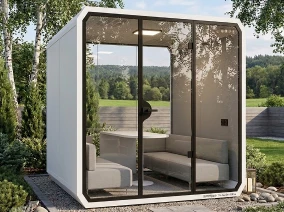
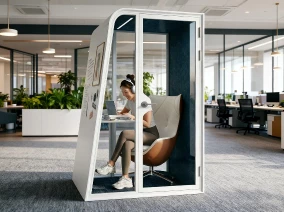
Why are more and more companies installing office pods?
Release time: 2026-08-28
In May 2026, if you walk into any Grade-A office building in Beijing’s Guomao, Shanghai’s Lujiazui, or Shenzhen’s Nanshan Science and Technology Park, you are highly likely to spot a few small, glass-walled cubicles tucked away in a corner.
Some people sit inside making phone calls or joining video conferences, while others simply use them as temporary workstations for the afternoon. These units go by various names—soundproof pods, silence pods, office pods, or phone booths—but they all serve the same purpose: providing a quiet space amidst the bustle of an open-plan office.
Three years ago, these pods were still a novelty; most companies viewed them merely as a nice-to-have office feature or a prop for tech firms to showcase their commitment to employee well-being.
By 2026, however, the landscape has shifted. They are evolving from an optional “bonus” into an essential requirement. This report aims to answer three key questions: How large is this market? What is driving the surge in demand? And what constitutes a high-quality soundproof pod?
Data sources include multiple third-party market research firms (such as Intelmarketresearch, QYResearch, Valuates Reports, and MarkNtel Advisors), industry media reports, and publicly available corporate information. All data points are cited with their respective sources.

Part I: The Rise of a Ten-Billion-Yuan Market—The Data Speaks for Itself
1.1 Global market size: grew from 450 million to 910 million in just eight years.
Let’s start with the key figures.
In 2024, the global market for soundproof office pods and booths was valued at approximately $453 million (Intelmarketresearch, 2025). By mid-2025, the market was estimated to have reached $512 million. Based on current growth rates, this figure is projected to surpass $912 million by 2032—more than doubling within eight years.
10.6% CAGR (2025–2032) · Source: Intelmarketresearch.
A compound growth rate of 10.6% is highly impressive within the office equipment category—especially when compared to the traditional office furniture market, which typically sees growth of around 3–5% over the same period. The growth driven by soundproof pods is essentially the result of a combination of “replacement of existing stock” and “newly generated demand.”
1.2 Regional distribution: North America is the largest, followed by Asia-Pacific, but the overall trend is one of growth.
The market landscape for 2024 is clear: North America is the dominant force, capturing approximately 42% of the global market share (Intelmarketresearch, 2025).
US technology companies and financial institutions constitute the largest buyer segment. Europe accounts for about 30% of the market, led by Germany, the UK, and the Nordic countries. A distinctive feature of the European market is its more stringent requirements regarding sustainable materials and design aesthetics.
The Asia-Pacific region is the one truly accelerating; with a projected CAGR of 14.2%, it is the fastest-growing region globally.
1.3 Product Structure: Single-person cabins account for 55%, while multi-person models are catching up.
Single-person soundproof pods (accommodating 1–2 people) account for approximately 55% of the market share.
However, the growth rate of multi-person models (4–6 person meeting pods) is overtaking that of single-person units—driven by the rise in video conferencing and the lack of spaces with closable doors for meetings in open-plan offices.
Data from leading brands indicates that order volumes for meeting pods grew by more than 40% year-on-year for the 2024–2025 period.

Part 2: Breakdown of Five Major Trends
2.1 Hybrid work shifts from an “emergency measure” to a “permanent policy.”
74% of U.S. companies have adopted hybrid work as a permanent policy.
A direct consequence of this shift is that the function of the office has changed: it has evolved from a place for “getting work done” into a place for “connecting with others.”
This implies one thing: offices need more small, enclosed spaces. Soundproof pods fill this gap perfectly; they require no structural demolition—simply move them in, plug them in, and they are ready to use.
2.2 Noise—The Biggest “Hidden Tax” in the Office
Noise in open-plan offices can reduce cognitive performance by 66%.
60% of employees report that noise in open-plan offices disrupts their focus multiple times a week. After each interruption, it takes an average of 23 minutes to regain a state of deep work.
Multiply 23 minutes by five interruptions a day, and nearly two hours of deep work time vanish.
The decision-making process for purchasing soundproof pods has shifted from being solely an administrative call to a joint initiative driven by both HR and Administration; these pods address not only efficiency issues but also employee retention and the employer brand.
2.3 ESG and employee health become hard metrics for procurement.
By 2026, ESG has shifted from being a “bonus” in investment circles to an “entry threshold” within supply chains.
When large enterprises procure office equipment, metrics such as environmental certifications, carbon footprint data, and material recyclability rates are becoming standard fields in tender documents.
Environmental factors influence 42% of corporate procurement decisions. The European market is particularly sensitive to this; without CE certification and RoHS compliance reports, products generally cannot make it onto distributors’ procurement lists.

2.4 Smart Office: From Concept to Implementation
Over 60% of enterprises are implementing smart office technologies, and 35% of high-end office pods are already equipped with IoT sensors. Air quality monitoring, occupancy management, and touchless controls—these are no longer mere “concepts” but “essential requirements.”
Part 5: Four Recommendations for Procurement Decision-Makers
- Look at sound insulation data rather than just marketing slogans; prioritize products with third-party test reports. Focus on two key metrics: sound insulation rating and reverberation time.
- Ventilation is not a mere bonus feature but a core function; in an enclosed space, CO2 levels can spike to a drowsiness-inducing level within just 20 minutes. Step inside, close the door, and stay for 10 minutes—if it doesn’t feel stuffy, the ventilation is generally adequate.
- Check for actual certification; “compliant with standards” is not the same as “CE certified.” In the context of tenders and bidding, the weight of an official certificate is vastly different.
- Modular designs are more valuable than fixed ones.

