


Introduction to Sound Insulation Technology in Buildings
Release time: 2026-06-11
How Soundproofing Is Reshaping Modern Spaces: From Noise Control to Privacy Protection
According to global workplace research by Gensler, demand for focused workspaces and private communication areas continues to grow, particularly in hybrid work environments.
At the same time, the increasing use of video conferencing and remote collaboration has made voice communication a constant part of daily work. Modern buildings are no longer designed simply to accommodate more people—they are expected to support productivity, privacy, comfort, and overall well-being.
While open-plan offices improve space efficiency and encourage collaboration, they also create significant acoustic challenges.
A study by the International Facility Management Association found that more than 60% of office employees consider noise one of the primary factors affecting productivity and concentration. This highlights that workplace noise is no longer a minor annoyance—it is a significant performance issue.
Research conducted by the Harvard T.H. Chan School of Public Health further suggests that prolonged exposure to workplace noise can increase stress levels while reducing cognitive performance and task efficiency.
Beyond noise control, privacy protection has become equally important. In open environments, business negotiations, HR interviews, client conversations, and even healthcare-related discussions may be unintentionally overheard by others nearby.
The World Health Organization also notes in its environmental noise guidelines that long-term exposure to excessive noise can negatively impact sleep quality, cognitive function, and overall health.
As a result, modern acoustic design is no longer focused solely on reducing noise. It now plays a critical role in improving productivity, protecting privacy, and enhancing the overall user experience within a space.
The Core Principle of Soundproofing: Controlling Sound Transmission
Many people assume that soundproofing means creating a completely silent environment. In architectural acoustics, however, the objective is not to eliminate sound entirely but to control how sound travels between spaces.
The Acoustical Society of America identifies four key factors that influence acoustic performance in buildings:
- Material mass and density
- Structural decoupling (vibration isolation)
- Sound absorption and reverberation control
- Airtightness and sealing quality
In simple terms, soundproofing is the management of sound energy transfer between spaces.
For example:
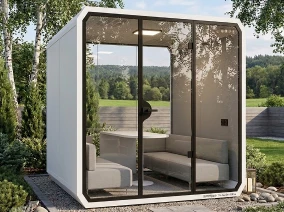
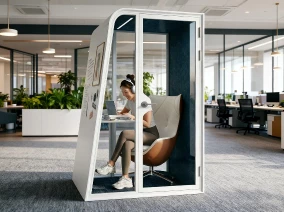
- Preventing conversations inside a meeting pod from being heard outside
- Protecting patient consultations from being overheard in adjacent areas
- Ensuring music production activities do not disturb nearby occupants
- Reducing the intrusion of traffic noise into interior spaces
Why Thicker Walls Alone Are Not Enough
A fundamental principle in architectural acoustics states:
“Sound will always find the weakest path.”
Research from the National Research Council Canada has shown that sound leakage in real-world buildings often occurs not through the wall itself, but through gaps, joints, doors, windows, and other weak points in the building envelope.
This means that even if a wall has excellent acoustic properties, small sealing deficiencies can significantly compromise overall sound isolation performance.
For this reason, modern acoustic design relies on a system-based approach that combines:
- Multi-layer composite structures
- Vibration isolation systems
- High-performance sealing solutions
- Sound-absorbing materials
Effective soundproofing is therefore not achieved through a single material but through the coordinated performance of multiple components working together as an integrated system.
How Soundproofing Works
From an engineering perspective, effective sound isolation is based on four fundamental principles:
- Increasing resistance to sound transmission
- Interrupting vibration transfer paths
- Absorbing excess sound energy
- Preventing air leakage that allows sound to escape
This is why modern acoustic pods, soundproof rooms, and acoustic doors typically incorporate multi-layer construction systems that combine different materials and structural techniques.
The concept is similar to thermal insulation: performance is determined not by a single layer, but by how multiple layers work together as a complete system.
Different Spaces Require Different Acoustic Standards
There is no universal definition of a “quiet” environment because acoustic requirements vary depending on the intended use of the space.
As a general reference, the World Health Organization recommends that nighttime noise levels in residential environments remain below 30 dB to minimize sleep disturbance.
Typical sound levels include:
| Environment | Typical Noise Level |
|---|---|
| Open-plan office | 50–65 dB |
| Normal conversation | Approximately 60 dB |
| Quiet office environment | 40–45 dB |
| Recording studio | 20–30 dB |
Office Environments (40–45 dB)
Acoustic comfort in offices directly influences concentration, communication quality, and employee productivity.
Healthcare Environments (35–40 dB)
Speech privacy and reduced stress levels are critical considerations in hospitals, clinics, and consultation rooms.
Music Production and Content Creation Spaces (20–30 dB)
Professional recording, broadcasting, and content creation require highly controlled acoustic conditions to ensure sound accuracy.
Sleep Environments (≤30 dB)
Sleep is particularly sensitive to noise disturbances.
According to the World Health Organization, noise levels above 30–40 dB can negatively affect sleep continuity and recovery quality.
As a result, airport sleep pods, hotel guestrooms, wellness facilities, and recovery spaces increasingly rely on advanced acoustic design and high-performance soundproofing solutions.
The Future of Acoustic Design in Modern Buildings
Both the WELL Building Standard and LEED certification systems now include acoustic performance as an important evaluation criterion, underscoring the growing role of sound management in building design.
Research from JLL and Gensler indicates that future workplace design is increasingly focused on:
- Focus work areas
- Small meeting spaces
- Private communication zones
- Flexible and modular environments
Against this backdrop, acoustic pods, soundproof rooms, and modular sound isolation systems are evolving from optional amenities into essential components of modern workplace and architectural design.
As organizations place greater emphasis on productivity, privacy, employee well-being, and user experience, soundproofing is becoming a strategic element of building performance rather than merely a technical consideration.