


The History of Office Pods
Release time: 2026-07-30
The development of office pods is essentially the result of an evolution in office spaces—moving from centralized work to open-plan offices, then to flexible work arrangements, and finally to a demand for private, individual space. They did not appear overnight but are the product of decades of changing workplace models.
1:Traditional Office Era (Early 20th Century – 1960s)
Background: Dominated by enclosed office layouts; early corporate office setups primarily featured private offices, large open-plan halls, and rows of fixed employee workstations.
Characteristics: ✅ Good privacy, ❌ Low space utilization, ❌ Limited communication efficiency.

2:The Rise of Open-Plan Offices (1960–2000)
Background: Driven by the pursuit of efficiency and cost-effectiveness, open-plan offices became widespread after the 1960s. Key features included expansive office areas, shared spaces, and flexible workstations. Office partition systems emerged as a low-cost method to delineate individual zones. However, issues gradually arose: noise from phone calls and conversations disrupted concentration, privacy was lacking, and video conferencing proved difficult.
This gave rise to a primary need: “A small, quiet space within the open-plan environment.”
3:The Emergence of Office Pods (2000–2015)
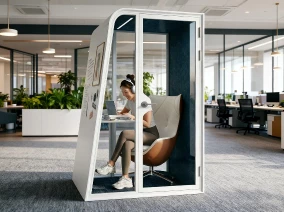
The concept evolved from the telephone booth into a workspace solution. Its earliest form was the basic “phone booth”—a simple, sound-insulated enclosure for a single person to make calls. Later upgrades—such as the addition of seating, lighting, ventilation, and power outlets—transformed it into the “office pod.”
A key milestone occurred around 2010, when the market commercialized these units by launching acoustic office pods designed to address noise issues in open-plan offices.
The core focus of products during this stage was resolving issues related to noise and privacy.

4. Intelligent and Modular Stage (2015–2020)
Office pods began to evolve from “soundproof boxes” into “miniature offices.”
5:Pandemic-Driven Phase (2020–2023)
The pandemic transformed work models, giving rise to remote and hybrid work. Many households faced challenges such as working in living rooms or bedrooms, noise disturbances, and a lack of dedicated meeting space.
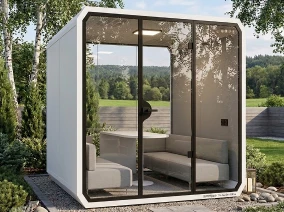
Office pods began to appear in homes and backyards.

6:Current Phase (2023–Present)
The current trajectory of office pod development:
① More like architecture than furniture
Previously:
Office pod = Oversized furniture.
Now:
Office pod = Micro-architectural space.

