


How to Reduce Office Noise and Improve Privacy with Soundproof Office Pods?
Release time: 2026-06-03
Why Workplace Noise Has Become a Serious Challenge in Modern Offices
Open-plan offices have become the default workspace design for many companies. They encourage collaboration, improve space utilization, and support more flexible working styles. However, as this model becomes more widespread, two persistent issues have emerged: noise distraction and lack of privacy.
In typical open office environments, background noise levels usually range between 45–60 dB. In industrial offices, warehouses, or production-adjacent environments, noise levels can even reach 75–85 dB. By comparison, most studies suggest that the optimal acoustic environment for focused work, data analysis, design tasks, and important communication should be kept below 40–50 dB.
When noise consistently exceeds this level, employees are more likely to experience reduced concentration, lower productivity, and higher cognitive fatigue.
Common sources of workplace noise include conversations between colleagues, phone calls, video meetings, office equipment, HVAC systems, traffic noise, and even machinery from nearby industrial areas. Among these, speech is often the most distracting because the human brain naturally pays attention to intelligible conversations.
At the same time, privacy has become a growing concern. Sensitive discussions such as client meetings, HR interviews, financial planning, and internal strategy conversations often take place in open environments where information can easily be overheard.
As a result, Office Pods, Phone Booths, Meeting Pods, and modular acoustic rooms have become increasingly popular solutions for modern workplaces.
Different Office Tasks Require Different Levels of Acoustic Privacy
Not all work requires a fully enclosed office. However, many tasks benefit from a controlled acoustic environment that balances privacy, focus, and communication quality.
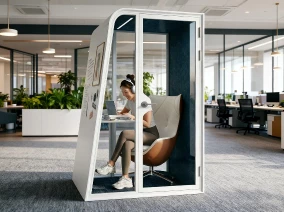
Phone Booths for Calls and Online Meetings
Single-person phone booths are widely used for video calls, remote meetings, interviews, and focused individual work.
In open offices, even one phone call can easily disturb nearby employees. Research shows that speech is one of the most distracting types of noise in workplaces because it is easy for the brain to recognize and follow.
A dedicated phone booth helps isolate conversations while reducing background noise interference, improving communication clarity for both sides.
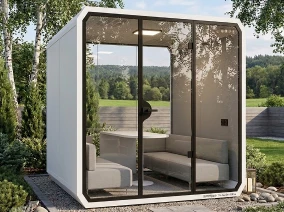
Small Meeting Pods for Private Discussions (2–4 People)
Small meeting pods are commonly used for client meetings, HR interviews, one-on-one discussions, and confidential conversations.
Compared to traditional meeting rooms, these pods require less space while still providing a high level of acoustic privacy and a more comfortable communication environment.
Medium Meeting Pods for Team Collaboration (4–6 People)
Medium-sized meeting pods are designed for team discussions, brainstorming sessions, and video conferences.
By containing group conversations within a dedicated space, they help maintain productivity in surrounding work areas while ensuring effective collaboration inside the pod.
Acoustic Rooms for Focused Work
Large acoustic rooms can function as private offices, executive spaces, or quiet working zones.
In environments such as factories, warehouses, R&D centers, or logistics facilities, background noise often exceeds comfortable working conditions. In these cases, acoustic rooms provide a stable, quiet environment for high-focus tasks and sensitive discussions.
Why More Companies Are Choosing Office Pods Instead of Building Meeting Rooms
Traditionally, companies relied on permanent construction to create meeting rooms or private offices.
However, this approach often comes with several limitations:
- Long construction timelines
- High renovation costs
- Limited flexibility after installation
- Disruption to daily operations during renovation
Office Pods offer a more flexible alternative.
Because they are modular and prefabricated, they can be installed quickly with minimal disruption. They can also be relocated, reconfigured, or reused as business needs evolve.
For companies that prioritize flexibility and long-term cost efficiency, Office Pods are often a more practical solution than traditional construction.
How Office Pods Achieve Effective Noise Reduction
The acoustic performance of an office pod is not achieved by a single material, but by a combination of engineering principles working together.
Sound travels through both air and solid structures. Human speech mainly falls within the mid-frequency range, while traffic noise, HVAC systems, and industrial machinery often generate low-frequency sound, which is more difficult to control due to its stronger penetration ability.
Modern office pods achieve sound reduction through four key mechanisms: sound insulation, sound absorption, vibration damping, and airtight sealing.
High-Density Materials Block Sound Transmission
The outer structure of an office pod acts as the first barrier against noise.
High-quality pods typically use aluminum frames, tempered glass, and galvanized steel panels. These materials provide structural strength while helping reduce airborne sound transmission.
According to the acoustic mass law principle, heavier and denser materials generally provide better sound insulation because they resist vibration caused by sound waves.
Multi-Layer Wall Construction Improves Acoustic Performance
Modern office pods use multi-layer composite wall systems rather than single-layer panels.
Typical structures may include:
- Sound insulation membrane
- Polyurethane acoustic foam
- Composite acoustic boards
- WPC acoustic wall panels
- Polyester fiber acoustic panels
Each material serves a different purpose—blocking sound, absorbing vibration, or dissipating acoustic energy.
Together, these layers significantly improve overall sound insulation performance across a wide frequency range.

Controlling Mid- and Low-Frequency Noise
Noise from air-conditioning systems, road traffic, and industrial equipment is often concentrated in the low-frequency range, which is the most difficult to control in office environments.
Polyurethane acoustic foam features an open-cell structure that helps absorb sound energy and reduce vibration transmission, improving the internal acoustic environment of the pod.
Improving Speech Clarity Inside the Pod
Effective acoustic design is not only about blocking external noise—it also needs to ensure clear and comfortable communication inside the space.
Without proper sound absorption, sound waves can reflect off hard surfaces and create echo or reverberation, reducing speech clarity.
Polyester fiber acoustic panels help absorb reflected sound, reduce reverberation time, and improve speech intelligibility, making phone calls and video meetings more natural and efficient.
Why Airtight Sealing Is Critical
Even high-performance acoustic materials will lose effectiveness if sound leaks through gaps.
Common leakage points include door edges, panel joints, cable entry points, and structural connections.
High-quality office pods typically include:
- Acoustic sealing door systems
- Multi-layer sealing gaskets
- Airtight structural joints
- Sealed cable management systems
In real-world applications, sealing performance is often just as important as wall materials.
The Value of Office Pods Goes Beyond Noise Reduction
While noise reduction is often the primary reason companies invest in office pods, their value extends much further.
Office pods help organizations create flexible workspaces without permanent construction. They improve employee focus, enhance meeting efficiency, and provide secure environments for confidential communication.
In addition, their modular and reusable design supports more sustainable workplace planning by reducing renovation needs and construction waste.
As workplace design continues to evolve, more companies are shifting away from large fixed meeting rooms and toward flexible combinations of collaborative and quiet spaces.
Understanding Acoustic Performance: It’s Not About Silence
It is important to understand that office pods are not designed to eliminate sound completely. Instead, they reduce sound transmission and improve acoustic comfort.
In most workplace scenarios, the goal is not absolute silence, but rather:
- Reducing speech distraction
- Improving privacy
- Creating a comfortable acoustic environment
This is why high-quality Office Pods focus on balancing:
- Sound insulation performance
- Speech privacy
- Acoustic comfort inside the space
rather than relying on a single acoustic number.
Final Thoughts
Workplace noise is no longer just a comfort issue—it directly affects productivity, communication quality, and information privacy.
As modern work environments continue to evolve, Office Pods are shifting from optional furniture to essential workplace infrastructure.
Office Pods, Phone Booths, Meeting Pods, and acoustic rooms provide a practical, fast, and flexible solution for improving office environments without complex renovation work.
By combining sound insulation materials, multi-layer wall systems, vibration control technology, and airtight structural design, modern office pods effectively reduce noise interference while improving communication quality and workplace experience.
As demand for flexible and human-centered office design continues to grow, modular acoustic solutions are becoming a key direction in the future of workplace development.As part of modern modular workspace solutions, Office Pods are increasingly being adopted in open-plan offices, co-working spaces, R&D centers, industrial facilities, and commercial buildings. Compared to traditional construction, their fast deployment, flexibility, reusability, and sustainability make them a key driver in the future of workplace design